Find and fix AI failures before your users do.

Reliai turns regressions into incidents, shows you what changed, and proves the fix worked.

Incident INC-1423

Hallucination spike detected

AI Support Copilot · Production · Mar 11, 10:22 AM

CRITICAL

Before

19%

failure rate

Baseline

4%

healthy

After Fix

19%

near baseline

Root Cause — 71% confidence

Prompt v42 deployed 82 minutes before incident

Recommended Fix

Revert to v41

Fix Verified

Failure rate reduced from 19% → 5%

After reverting prompt v42

Resolved in 6 minutes

✓ Based on real production traces

⚡ Incident opened automatically🔍 Prompt v42 identified at 71% confidence✅ 19% → 5% — resolved in 6 minutes

AI Reliability Audit

7-day done-for-you audit to surface hidden failure modes before they reach users.

See the audit offer

Works with

OpenAIAnthropicLangChainLlamaIndexCustom pipelines
First incident detected in under 30 seconds

How it works

From failure to fix — without manual triage.

Observability tells you something changed. Reliai tells you what broke and why.

Detect

Risk surfaces before a single user is affected.

Every deployment runs through the Reliai safety gate — scoring retrieval regression probability, guardrail gaps, and cross-organization failure patterns. A WARNING or BLOCK decision surfaces before rollout with a specific risk score and the exact factors driving it, so you catch issues before they reach production.

app.reliai.dev/deployments
Deployment safety gate showing WARNING decision with risk score and regression factors

Compare

Current window vs. baseline, assembled for you.

The cohort diff is pre-built from the incident window — current traces vs. baseline traces, side by side. Every dimension that changed is flagged: prompt version, model name, refusal signal, output validity, latency, cost. No query to write.

app.reliai.dev/compare
Cohort diff view showing current versus baseline trace comparison

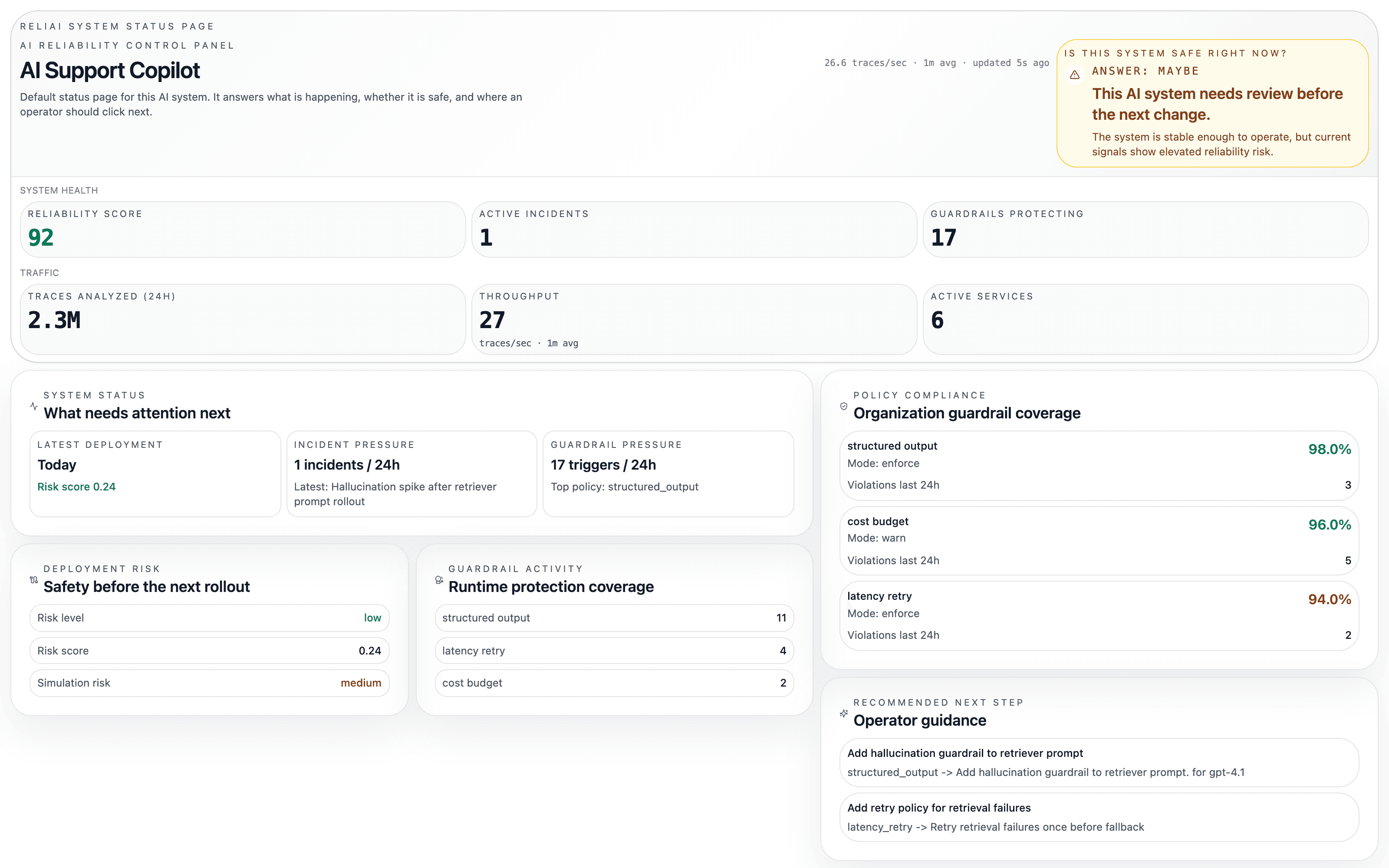
Act

From signal to action — no log diving required.

The reliability control panel surfaces what needs attention next: active incidents, deployment risk, guardrail coverage, and specific operator guidance. When something degrades, the exact prompt version, retrieval failure, or guardrail gap is already surfaced. You go from alert to fix without writing a single query.

app.reliai.dev/incidents
Reliability control panel showing active incidents, risk score, and operator guidance

Failure coverage

Recognize any of these?

These are the failures teams discover late — hours into a user-facing incident, long after the signal was detectable. Reliai catches each one as it happens.

Refusal spike

Your model started refusing valid requests after a prompt update.

What Reliai does

Reliai measures refusal rate per trace window. When it crosses 15% absolute or doubles from baseline, a critical incident opens automatically.

Prompt regression

A prompt change shipped and behavior degraded — but all 200s, no alarms.

What Reliai does

Reliai compares current traces to the pre-rollout baseline and flags the prompt version responsible.

Output contract break

Your downstream system started receiving malformed JSON. Silently.

What Reliai does

Reliai validates structured output on every trace. A drop in validity rate opens an incident even when HTTP status is 200.

Latency degradation

Response times doubled after a model migration. Users noticed before the team did.

What Reliai does

Reliai tracks per-trace latency against the deployment baseline and surfaces the shift as a regression.

Retrieval drift

Your RAG pipeline started pulling off-topic chunks. Quality degraded gradually.

What Reliai does

Reliai's behavioral signals include custom retrieval quality metrics — you define the threshold, Reliai opens the incident.

Tool misuse

An agent started calling the wrong tool, or calling it with bad arguments, at scale.

What Reliai does

Instrument tool call outcomes as a custom metric. Reliai detects the spike and opens an incident with the affected trace cluster.

Behavioral signals

The signals that actually break AI systems.

Standard monitoring tells you a request succeeded. Reliai tells you whether the response was actually correct. These are not the same thing — and the gap is where production AI fails silently.

LLM safety drift

Refusal detection

Pattern-matches every trace output against evasion signals. When refusal rate spikes above threshold — 15% absolute, 50% relative — an incident opens at critical or high severity. The command center shows baseline vs. current rate and the contributing prompt version.

Policy violations

Custom metrics

Define what bad output means for your system. Regex pattern or keyword list. Match as boolean or count. When your metric spikes above threshold, Reliai opens an incident the same way it does for built-in signals.

Contract breakage

Structured output failures

If your AI is expected to return JSON, Reliai validates it on every trace. A drop in validity rate — even with no 5xx errors — opens an incident. No custom instrumentation required.

Evals test before you deploy. Reliai catches what evals miss — in production, in real traffic, in real time.

Positioning

Not observability. Not evals. Incident response.

ToolWhat it doesWhat’s missing
Langfuse, LangSmithLogs traces. Shows you what happened.No incidents. No root cause.
Arize, FiddlerML observability dashboards. Charts that drift.Not designed for LLM behavioral signals. No incident lifecycle.
Custom dashboardsYou build the queries. You set the thresholds.Ongoing maintenance. No root cause. No workflow.
ReliaiOpens incidents when behavior degrades. Walks you from failure to root cause to fix.

If you’re debugging AI with logs, you’re already too late. Reliai turns failures into incidents before they become user-facing problems.

See it live

A hallucination spike — detected, diagnosed, and fixed in 6 minutes.

No API key, no setup. Reliai generates a clean baseline, injects a hallucination spike, opens a real incident, and walks through root cause to verified fix — exactly as an operator would see it in production.

  1. 1Failure rate hits 19% — incident opens automatically, 4% baseline recorded
  2. 2Root cause scored: prompt v42 deployed 82 minutes before incident — 71% confidence
  3. 3Fix applied: revert to v41 — trace graph, cohort diff, and deployment gate all in one view
  4. 4Fix verified: failure rate drops from 19% → 5% — loop closes with proof, not assumption

From “something broke” to fix verified — with the cause named and the numbers proved.

app.reliai.dev/playground
Simulation playground running a synthetic incident scenario with refusal spike

Get started

Your AI is already in production. Is anyone watching it?

Reliai is the incident response layer for AI systems — the step between “something degraded” and “we know what to fix.”

No credit card. No setup. First incident detected in under 2 minutes.